Compliance and audit relief
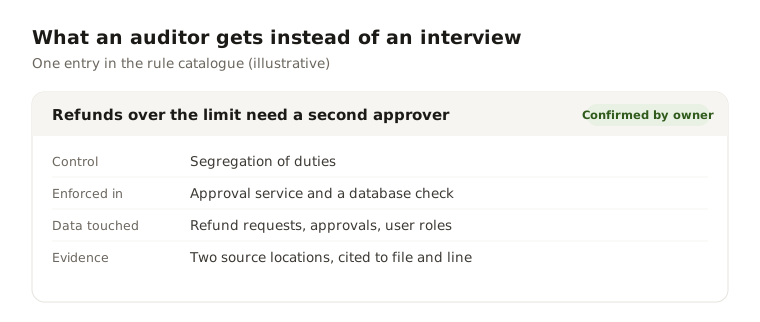
Regulators and auditors want evidence of how a system behaves. In most legacy estates that evidence lives in the heads of two engineers. ARC turns it into a cited, reviewable record.
The situation
The finding is familiar: insufficient documentation of how the system enforces a control. The evidence exists, in the code and in the heads of two engineers, and every audit cycle pulls them off their work to explain it again.
Auditors get evidence they can check. Engineers stop explaining from memory.
How ARC handles it
- Every rule written down.Business rules extracted from code and database, each with a plain-language description and a citation to the line that enforces it.
- Who can do what.Roles, permissions and the screens and data each one reaches, mapped from the code.
- Security findings mapped.Issues found in the audit, organized by control, with the evidence behind each one.
- Confirmed by the people accountable.Owners review and confirm the rules instead of writing them from scratch.
What you get
What this means for you
If your last audit took engineers off delivery for weeks, a cited rule catalogue pays for itself in the next cycle. Auditors get evidence they can check, and engineers stop explaining from memory.
Next step: a Discovery and Audit
Fixed scope and a fixed price set by the size of your code, from $1,000. You get the business-rule inventory, a security and risk map, a duplication and maintainability report, and a modernization plan with a cost estimate. You decide on the rest once you've seen it.
Read more
Timelines depend on access to code and people; we confirm them on the scoping call.