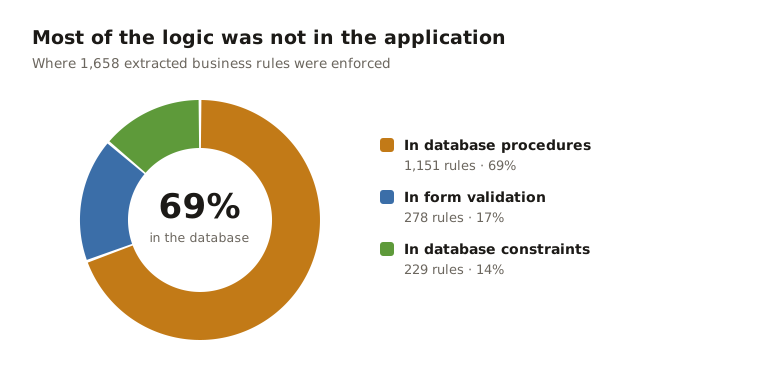
Two thirds of a legacy system's business rules were hiding in the database
A large enterprise's desktop admin tool kept most of its logic in Oracle. ARC traced more than 1,600 rules across the app and the database before any rebuild was planned, and found that fewer than a third needed rewriting.
- Customer
- Large enterprise, procurement operations
- Legacy
- VB.NET desktop app over Oracle PL/SQL
- Target
- Modern .NET API and React web screens
- Size
- Over 300,000 lines of code and SQL
- Engagement
- Discovery and Audit, architecture and plan
 Challenge
Half of every rule was somewhere else
An order was validated on the form, recalculated in the database and checked once more by a trigger. Neither half made sense alone. ARC's audit rated the code hard to maintain, found no automated tests, and found security issues in how the tool signed users in.
SolutionCount the rules by layer before deciding anything
- Discovery and Audit.ARC read the application and the database together and wrote down every rule, cited to the place it's enforced.
- Where each rule belongs.Every rule was assigned an owner: the new application, the database, or retirement with a reason.
- A target the client agreed.Keep the database logic that already works, and move the screens and the rest to a modern web stack.
- A plan, two days later.Once the architecture was signed off, the full rebuild plan followed in two days.
Rewriting the screens alone would have produced a system that looks right and behaves wrong.Outcome
Less to rebuild than anyone expected
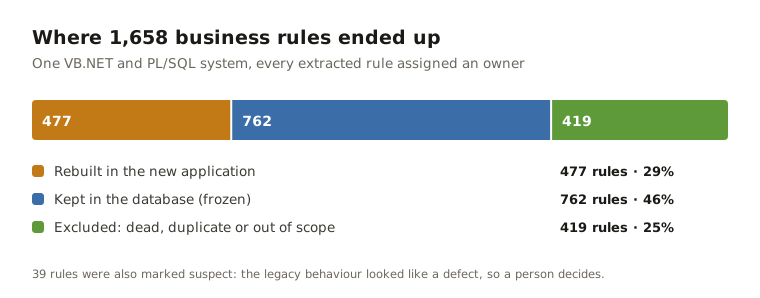
Only 29% of the rules needed rebuilding in new code. Almost half stay in the database, documented so the new code doesn't duplicate them. A quarter were retired, each with a reason. The handful that looked like defects went to the business owner to decide, instead of being silently fixed or copied.
What you get
What this means for you
If a large share of your logic lives in stored procedures, a screen-by-screen rewrite will look right and behave wrong. Count the rules by layer first. It tells you how much really has to move, and how much can stay where it is.
Next step: a Discovery and Audit
Fixed scope and a fixed price set by the size of your code, from $1,000. You get the business-rule inventory, a security and risk map, a duplication and maintainability report, and a modernization plan with a cost estimate. You decide on the rest once you've seen it.
Read more
Timelines depend on access to code and people; we confirm them on the scoping call.