Buy-and-build: which of the acquired apps do you keep?
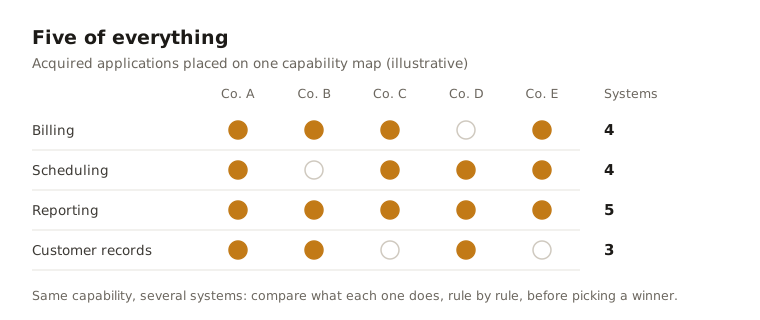
Every add-on brings its own billing, scheduling and reporting systems. Twelve acquisitions in, the platform runs five of everything. ARC shows what each one actually does, so the keep, merge or retire call rests on evidence.
The situation
By the time a platform has made a dozen acquisitions, every integration project starts with the same argument: which of the several billing, scheduling and reporting systems to keep.
Names don't tell you overlap. Two billing systems can share a word and differ in every rule that matters: proration, credits, tax. Picking a winner without that comparison means rediscovering the differences in production.
Two systems can share a name and differ in every rule that matters.
How ARC handles it
- One map.Every acquired application tiered, owned and placed on a single capability map.
- Rule-level comparison.For systems that serve the same capability, the rules each one enforces are compared side by side.
- A priced decision.Keep, merge or retire per application, with the evidence and the cost of each move.
What you get
What this means for you
If integration keeps stalling on which system wins, the missing input is usually a comparison of what each one actually does. That's a few weeks of discovery, not a year of workshops.
Next step: a Discovery and Audit
Fixed scope and a fixed price set by the size of your code, from $1,000. You get the business-rule inventory, a security and risk map, a duplication and maintainability report, and a modernization plan with a cost estimate. You decide on the rest once you've seen it.
Read more
Timelines depend on access to code and people; we confirm them on the scoping call.