Cost and complexity takeout
Most legacy platforms cost more to keep alive than to run. The savings are real, but they hide in dead code, duplicated services and infrastructure sized for a peak that stopped happening years ago.
The situation
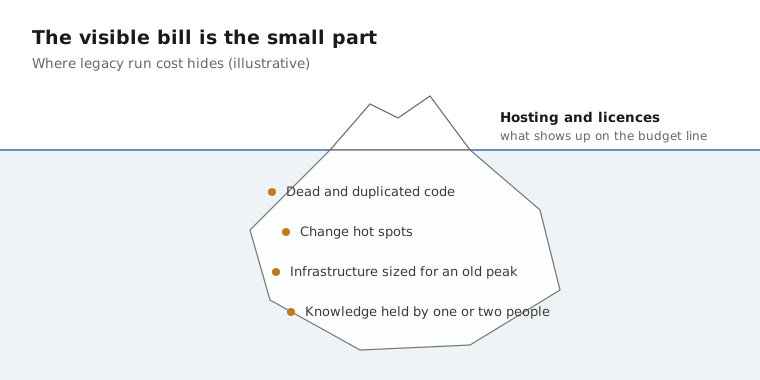
Run cost shows up as hosting and licences. The larger share is harder to see: engineers maintaining code nothing calls, the same logic fixed twice in two places, infrastructure still sized for a peak that stopped years ago, and a few people nobody can afford to lose.
The savings are real. They're just not on the budget line.
How ARC handles it
- Dead and duplicated code.Paths nothing calls and logic copied between modules, each cited.
- Change hot spots.The files that absorb most of the maintenance effort.
- Maintainability, measured.A score per component, so debt is ranked rather than argued about.
- Infrastructure against usage.The target sized to what the system does today, with a payback number.
What you get
What this means for you
If the budget conversation keeps ending at "it's complicated", a measured inventory of waste turns it into a list with numbers next to it. That's a better starting point for a CFO than a rewrite estimate.
Next step: a Discovery and Audit
Fixed scope and a fixed price set by the size of your code, from $1,000. You get the business-rule inventory, a security and risk map, a duplication and maintainability report, and a modernization plan with a cost estimate. You decide on the rest once you've seen it.
Read more
Timelines depend on access to code and people; we confirm them on the scoping call.