Rationalizing a thousand-application estate
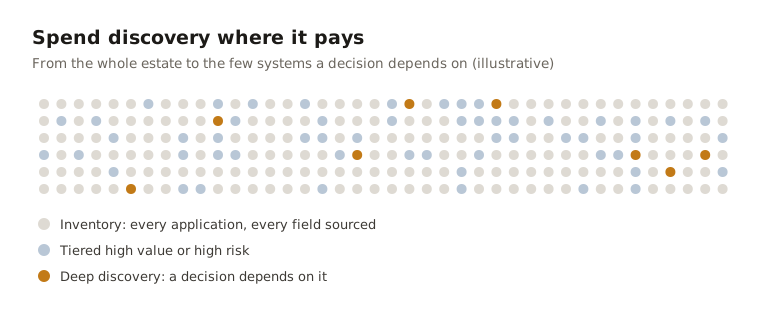
Large estates don't need discovery on every application. They need an honest inventory, a way to tier it, and deep analysis only where a decision depends on it.
The situation
Most estates already have an application list. It was built from surveys and exports, half its fields are stale, and nobody trusts it enough to make a decision from it.
Provenance is the point. A field nobody can trace back to a source gets ignored the first time it's wrong.
A field nobody can trace to a source gets ignored the first time it's wrong.
How ARC handles it
- Start with what you have.Load the existing inventory. Every field records where it came from.
- Tier by value and health.Criticality, technology age and support risk, side by side.
- Find the gaps fast.DR, support, security and ownership gaps across the portfolio.
- Go deep selectively.Discovery only on the applications where the decision needs it.
What you get
What this means for you
If you have hundreds of applications and a modernization budget for a handful, the first job is ranking, not analysis. Spend discovery where it changes a decision.
Next step: a Discovery and Audit
Fixed scope and a fixed price set by the size of your code, from $1,000. You get the business-rule inventory, a security and risk map, a duplication and maintainability report, and a modernization plan with a cost estimate. You decide on the rest once you've seen it.
Read more
Timelines depend on access to code and people; we confirm them on the scoping call.