Ready for AI-assisted engineering
Coding assistants are only as good as their understanding of the code they're in. In a twenty-year-old codebase, that understanding doesn't exist yet. ARC builds it, then hands it to your agents.
The situation
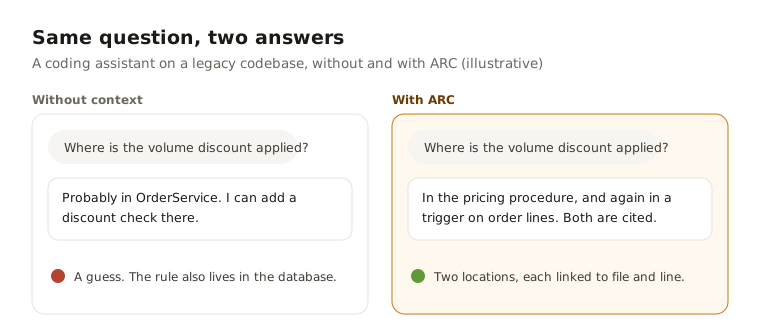
Assistants that do well on a fresh codebase stall on legacy code. They can't see the rule in the stored procedure or the integration nobody documented, so they guess, and the guesses break things.
The fix for disappointing assistants on legacy code is context, not a better model.
How ARC handles it
- One map of the whole estate.Code, business rules and the data model, searchable by plain-language question or by name.
- An MCP server for your agents.Your coding agents query ARC directly, with each query scoped to the calling user's permissions.
- Documentation that lives with the code.Generated from the code and kept with it, not in a wiki nobody updates.
- Or rebuild it to be agent-friendly.Typed, tested, documented code if you choose to move.
What you get
What this means for you
If your teams already use coding assistants and the results on legacy code are disappointing, the fix is context, not a better model. Give the assistant the map first.
Next step: a Discovery and Audit
Fixed scope and a fixed price set by the size of your code, from $1,000. You get the business-rule inventory, a security and risk map, a duplication and maintainability report, and a modernization plan with a cost estimate. You decide on the rest once you've seen it.
Read more
Timelines depend on access to code and people; we confirm them on the scoping call.