Carve-outs start with an application map. Most programs don't have one.
A divested business has to stand up its own systems while the parent keeps the lights on under a transition agreement. The first deliverable of every separation is an inventory of what runs where. ARC builds it from the code.
The situation
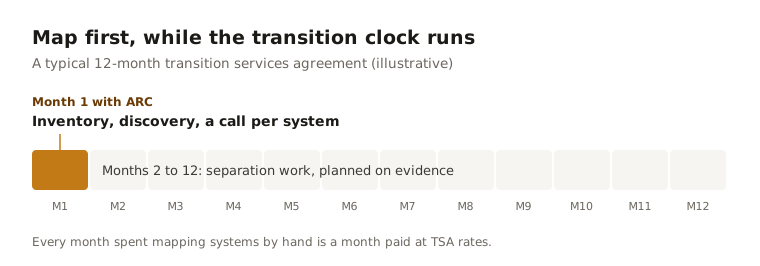
In a carve-out the seller keeps running IT for the divested business under a transition services agreement. These commonly run 6 to 24 months, and extensions usually cost more. Every month spent working out which systems the new company depends on is paid at TSA rates.
Most organizations have an application list built from surveys and CMDB exports. It's out of date, and it says nothing about what each application does or which rules live inside it.
The question isn't "what applications do we have". It's "which of them does the new company need on Day 2, and what's tangled up inside them".
How ARC handles it
- Inventory in week one.Every application in one view: owner, region, tier, technology and the capabilities it supports. Fields derived from code say so.
- Discovery where it matters.The shared and critical systems are read into capabilities, rules, integrations and data, each cited to source.
- Overlap and dependencies.One capability map shows where the divested business shares a platform with the parent, and which integrations cross the line.
- A plan the steering group can sign.Target architecture and build order, written for the integration office as well as the engineers.
What you get
What this means for you
If you're between signing and close, the inventory is the thing to start now. It's cheap, it's fast, and every later decision about splitting, replicating or retiring a system depends on it.
Next step: a Discovery and Audit
Fixed scope and a fixed price set by the size of your code, from $1,000. You get the business-rule inventory, a security and risk map, a duplication and maintainability report, and a modernization plan with a cost estimate. You decide on the rest once you've seen it.
Read more
Timelines depend on access to code and people; we confirm them on the scoping call.